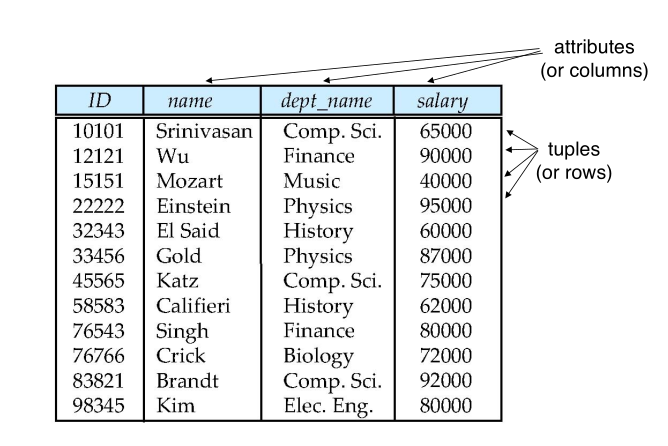
Example of a Relation Attribute Types The set of allowed values for each attribute is called the domain of the attribute Attribute values are (normally) required to be atomic; that is, indivisible The special value null is a member of every attribute The null value causes complication in the definition of many operations Relation Schema and Instance A 1 , A 2 , ⋯ , A n A_1, A_2, \cdots, A_n A 1 , A 2 , ⋯ , A n R = ( A 1 , A 2 , ⋯ , A n ) R = (A_1, A_2, \cdots, A_n) R = ( A 1 , A 2 , ⋯ , A n ) Formally, given sets D 1 , D 2 , ⋯ , D n D_1 ,D_2, \cdots, D_n D 1 , D 2 , ⋯ , D n D 1 × D 2 × ⋯ × D n D_1 \times D_2 \times \cdots \times D_n D 1 × D 2 × ⋯ × D n a 1 , a 2 , ⋯ , a n a_1, a_2, \cdots, a_n a 1 , a 2 , ⋯ , a n a i ∈ D i a_i \in D_i a i ∈ D i The current values(relation instance) of a relation are specified bu a table An element t of r is a tuple, represented by a row in a table Relations are Unordered Order of tuples is irrelevant (tuples may be stored in an arbitrary order) This is on the logical design level - ordering can be defined on physical level A database consists of multiple relations Information about an enterprise is broken up into parts
instructor, student, advisor Bad design: univ (instructor_id, name, dept_name, salary, student_id, ...)
results inrepetition of information (e.g., two student have the same instructor) the need for full values (e.g., represent a student with no advisor) Normalization theory deals with how to design "good" relational schemas(What is good) Keys superkey : K is a superkey of R if values for K are sufficient to identify a unique tuple of any possible relation r(R)
Drawbacks of using file systems to store data:
Data redundancy and inconsistencyMultiple file formats, duplication of information in different files Difficulty in accessing dataNeed to write a new program to carry out each new task Data isolationmultiple files and formats Integrity problemsIntegrity constraints become "burned" in program code rather than being stated explicitly. Hard to add new constraints or change existing ones Atomicity of updatesFailures may leave database in an inconsistent state with partial updates carried out Example: Transfer of funds from one account to another should either complete or not happen at all Concurrent access by multiple usersConcurrent accessed needed for performance and usability Uncontrolled concurrent access can lead to inconsistenciesExample: Two people reading a balance and updating it at the same time Security problemsHard to provide user/apps access to some, but not all, data Modern database systems offer solutions to all the above problems
Normal distribution, also known as Gaussian, Gauss, or Laplace-Gauss distribution, is a type of continuous probability distribution for a real-valued random variable. The general form of its probability density function is
f ( x ) = 1 f(x) = \frac{1}{} f ( x ) = 1
∂ ρ ∂ t + ∇ ⋅ j ⃗ = 0 \frac{\partial \rho}{\partial t} + \nabla \cdot \vec{j} = 0 ∂ t ∂ ρ + ∇ ⋅ j = 0 The graph depiction of normal distribution is called bell curve, because it looks like a bell.
The most commonly used locations for loading systemd files are
We can use man systemd.unit, man systemd.service commands to get some basic understanding about systemd.
A systemd unit could be one of the following type:
.service, .socket, .device, .mount, .automount, .swap, .target, .path, .timer, .slice, .scope
 Example of a Relation